
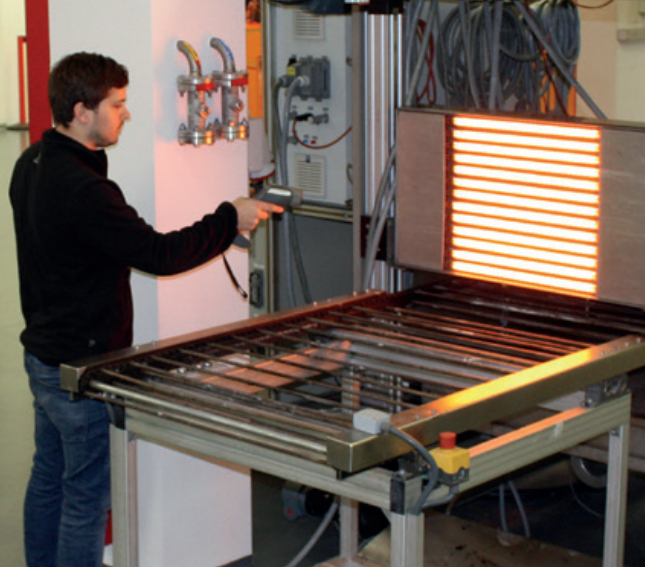
On the line, that wafer doesn’t wait. You get a few seconds, maybe, and in that window the photoresist has to see the same temperature profile as the last lot—and the next. Soft bake. Hard bake. The thermal budget is tight, and the acceptable energy window is measured in millijoules. A hot spot. A cold edge. A drift of a few tenths of a degree, and you’re moving critical dimension, lifting patterns, or embedding particles into the film. When the heating isn’t locked in, the yield isn’t either. We built linear infrared heating emitters for exactly that moment—high-volume fab work where temperature uniformity, cleanroom behavior, and uptime are table stakes. The emitter puts repeatable, localized heat on the substrate with tight control, and it supports photoresist bake steps, wafer drying, and other thermal processes where thermal mass is low and the tolerance is razor thin.
What matters, technically
At the core is a linear infrared source engineered for semiconductor thermal profiles, not general heating. It uses near-infrared (NIR) wavelengths matched to photoresist and common wafer substrate absorption, so the energy couples where it needs to and you don’t waste heat on fixtures. That gives you rapid thermal response with low thermal inertia—fast settling, and a quick cool-down between cycles. **Temperature uniformity is the spec that shows up on the wafer.**Across the heated zone, the emitter holds wafer-level uniformity within ±0.1°C at setpoint, measured on a standard test wafer under production airflow. That isn’t a lab number—it’s the difference between consistent CD control and excursions that show up on the CD-SEM. We get there with controlled irradiance distribution along the line, using a geometry and reflector design that cut edge loss and kill hot spots at the ends of the zone. Cleanroom compatibility is the other non-negotiable. The emitter body and support hardware are built to minimize outgassing and particle generation, and the design fits ISO Class 1 to Class 100 cleanrooms. Surfaces are smooth, joints are minimized, and materials are chosen for low particulation under continuous operation. In practice, particle counts stay stable over long runs. You don’t spend shifts chasing contamination that’s coming from the heating module. Then there’s repeatability. Setpoint accuracy is held within ±0.5°C, and the control loop settles quickly after stage motion and door events. The thermal profile stays consistent lot-to-lot and hour-to-hour, with drift below 0.1°C over 5,000 hours in typical bake profiles. That stability reduces setup and rework, and keeps the process window centered—not hovering at the edge. The emitter integrates into existing equipment with a compact linear form factor. Standard lengths cover common wafer sizes and multi-zone configurations, and the mounting interface aligns with semiconductor equipment standards. Electrical integration is straightforward, with options for 24 V control logic and mains voltage power connections. It’s built for 24/7 duty, with MTBF that matches fab uptime demands.
Why it works where it matters
Photoresist baking is where thermal control becomes visible, fast. In soft bake, you’re driving off solvent to a precise residual level. Go too low, and the film gets brittle. Go too high, and sensitivity shifts—exposure latitude changes right when you need it to stay put. In hard bake, you’re curing the photoresist to improve adhesion and etch resistance. Both steps need temperature that’s uniform across the wafer, stable over time, and repeatable across the lot. Linear infrared heating delivers that control with minimal thermal lag. The emitter heats the film directly, not the carrier or the stage, so temperature settles quickly after the wafer is placed. The low thermal mass design tracks setpoint changes without overshoot, and it cools fast when the bake is done—shortening cycle time and keeping wafers moving. The payoff is process stability: tighter critical dimension distributions, fewer defects tied to thermal non-uniformity, and less center-to-edge variation. It also supports advanced work—thin resist baking, multi-layer stacks, and low-temperature bakes where the thermal budget is constrained. The same fast response and tight uniformity apply when you’re drying patterned wafers after cleaning: uniform temperature prevents watermarks and reduces particle adhesion. Energy use is lower because the heat is targeted. You’re not dumping energy into the chamber; you’re putting it where it needs to be. That reduces facility cooling load and lowers operating cost without compromising performance. Reliability follows the same discipline. The emitter runs continuously without surprise shutdowns, and output stays stable over long periods—meaning fewer recalibrations and fewer replacements.
What you need to know
Linear infrared emitters are sensitive to the environment they run in. Airflow and chamber geometry affect uniformity, so installation has to respect recommended clearances and airflow management. If the equipment layout creates turbulence or recirculation, you can get small temperature oscillations—and you’ll see them as variation on the wafer. We provide mounting guidance and airflow baffles designed to stabilize the thermal field. Use them. Emissivity and substrate stack matter, too. Different films and substrates absorb infrared differently, and the temperature profile can shift when the stack changes. The control system needs to be tuned for the dominant stack in your process. If you run multiple films, build a calibration matrix and store the profiles. The emitter can handle multiple recipes, but it won’t compensate for an undocumented change in film stack on its own. There’s also a real integration trade-off. The emitter’s fast response is an advantage, but it needs a control loop that can keep pace. Older equipment may require a control upgrade to get the full benefit of settling time and repeatability. In practice, that’s a short investment in the controller and interface—and the payback shows up fast in less rework and higher throughput. Finally, the emitter is built for continuous operation, but like any precision thermal source, it performs best when you maintain it on schedule. Clean the quartz window and reflectors at the recommended intervals, and replace the emitter at the end of its rated life. The maintenance window is small and the steps are straightforward, but skip it and you’ll eventually see drift. If your process lives and dies by wafer tolerance, film temperature, and line reliability, the heating source has to match that discipline. Linear infrared emitters do—delivering uniformity, cleanroom-compatible operation, and repeatability that keeps the process in the window, lot after lot.